
Propane delivery works one of two ways. On automatic delivery we track how fast you burn gas and show up before you get low. On will call you watch the gauge and phone us. Most homes that heat with propane end up on automatic, because nobody wants to think about the tank in January.
This guide covers the whole thing, start to finish: how the two delivery types differ, how to read your tank, how much a house actually uses, what happens on delivery day, and what to do when something goes wrong. It is written for a homeowner in our part of Texas who has never had propane before, or who just bought a house with a tank in the yard and wants to know what they are looking at.
What is propane delivery?
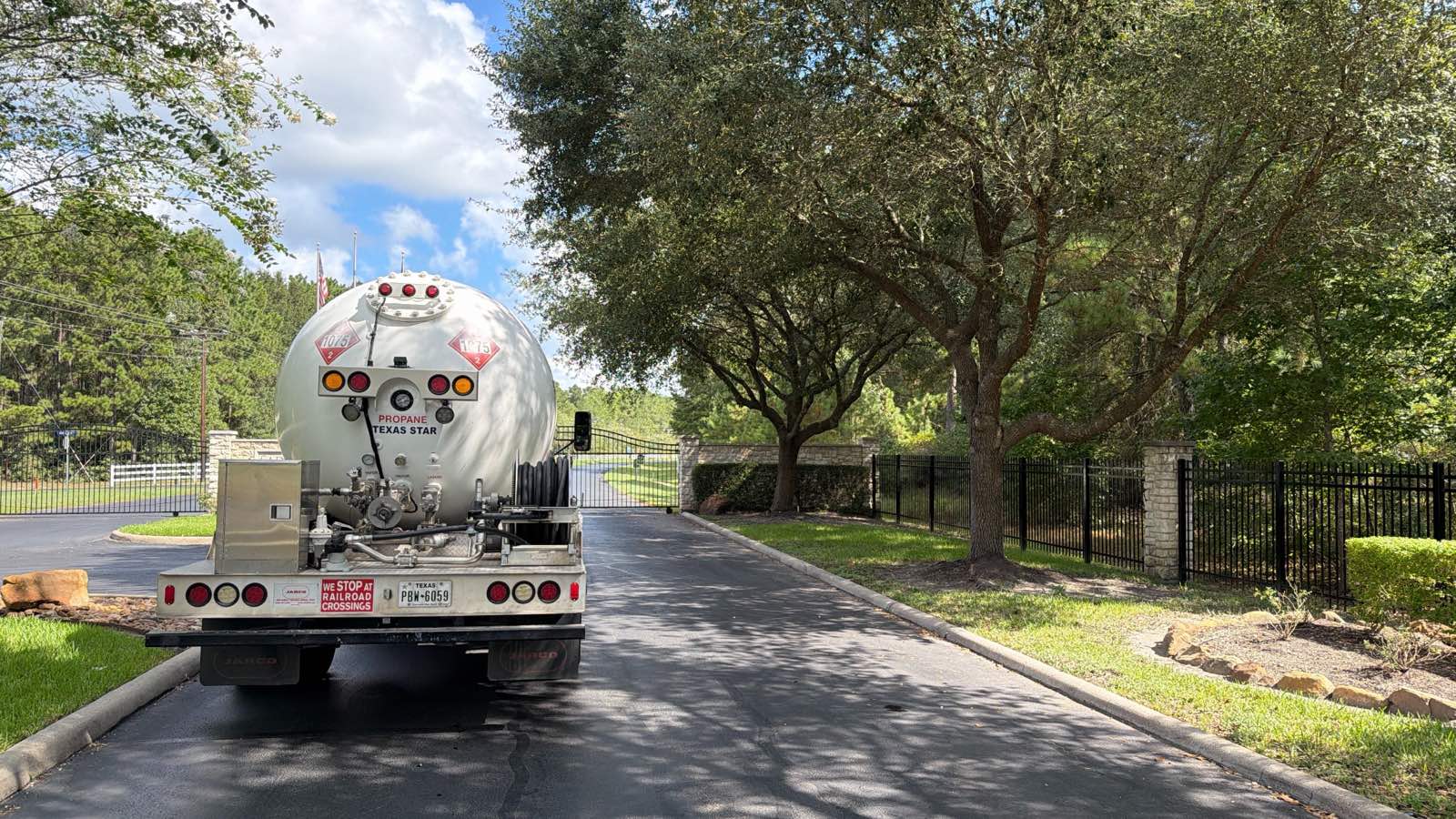
Propane is stored as a liquid under pressure in a tank on your property. It is delivered by a bobtail truck that pumps into that tank through a hose. You are not buying a cylinder and swapping it. You own or lease a fixed tank, and we keep gas in it.
That is the whole model. Everything else in this guide is detail on top of it: who decides when the truck comes, how you know where you stand, and what happens when the tank runs dry.
Should you be on automatic delivery or will call?
This is the first real decision you make, and it is the one that determines whether you ever think about propane again.
How automatic delivery decides when to come
Automatic delivery is not a guess and it is not a fixed calendar. We track how much gas you have used before and how cold it has been, and we work out when you will hit the point where you need a fill. The longer you are with us the sharper that gets, because we have more of your own history to work from. A first winter is the roughest estimate we will ever make for you.
When will call makes sense
Will call puts the watching on you. You read the gauge, you phone us, we put you on a route. That is a reasonable setup if the tank only runs a grill, a fireplace or a pool heater, where usage is light and you would notice it stopping. It is a poor setup for a house that heats with propane, because the tank empties fastest exactly when you are least likely to be checking it.
There is a minimum drop size on a will call order. Ask us what it is before you choose, and you will get a straight answer at the counter.
| Automatic delivery | Will call | |
|---|---|---|
| Who watches the tank | We do | You do |
| How an order starts | We calculate it from your usage | You phone us |
| Odds of running out | Low | Depends on you reading the gauge |
| Best for | Homes heating with propane | Grills, fireplaces, light or seasonal use |
| Planning needed from you | None | Check the gauge monthly in winter |
How do you know how much propane is left?
Lift the dome on top of the tank and you will find a round dial. That is your gauge, and learning to read it is the single most useful thing a propane customer can do.
The gauge reads percent, not gallons
The number on the dial is the percentage of the tank that is full, not the gallons in it. A 500 gallon tank sitting at 30 percent is holding roughly 150 gallons. The arithmetic is simple once you know that is what you are looking at, and a lot of people do not, which is how a tank gets to 10 percent with nobody worried about it.
Why a full tank reads 80 percent
A tank that has just been filled reads 80 percent, and that is correct. Propane expands when it warms up, and that top fifth of the tank is the room it needs to do that safely. If your gauge reads 80 after a delivery, you got a full tank.
We walk through the dial, what the numbers mean and how often to look in our guide to reading a propane tank gauge.
How much propane does a home actually use?
There is no single answer, and anyone who gives you one without asking about your house is guessing. What drives your usage is how many propane appliances you run, how cold the winter turns out, how well the house holds heat, and how many people live in it.
What moves the number most
Heating is the big one. A house that heats with propane will burn far more than a house using it only for cooking and hot water, and the gap widens in a cold year. Propane is one of the hydrocarbon gas liquids, and the US Energy Information Administration publishes the plain background on where it comes from and how households use it.
We break down what each appliance typically draws, and how to estimate your own year, in how much propane a home uses.
What happens if you run out?
Running out is not just an empty tank. When the tank empties the line loses pressure, and by law a technician has to run a leak check on the system before anything is relit. That is a scheduled service call, not a fill, which is why it costs more and takes longer than a normal delivery.
Why the test is not optional
An empty system can draw air and moisture in, and every pilot and appliance connection has to be confirmed tight before gas goes back through it. Our crew sits on national propane safety and standards committees, and this is the part of the job we do not bend on.
The steps to take the moment you realize the tank is dry are in what to do if you run out of propane.
What does propane smell like, and what should you do?
Propane has no natural smell. An odorant is added to it so you can tell when gas is escaping, and what it smells like is rotten eggs, or a skunk. If you smell that, treat it as real every single time.
Get everyone out, do not touch a light switch or anything else electrical, and phone us from outside the house. We would far rather drive out to a false alarm than have you talk yourself out of a real one. The full response, step by step, is in what propane smells like and what to do.
How do you get ready for a Texas winter storm?
People who have lived here a long time know what a hard freeze does to this part of the state. Roads close, trucks cannot run routes, and a tank that was fine on Monday is a problem by Thursday. The time to deal with that is before the forecast, not during it.
Keep the tank well above a quarter through the winter, keep the path to it clear, and know where your shutoff is. What to do before, during and after a freeze is covered in propane tank safety in winter storms.
What happens on delivery day?
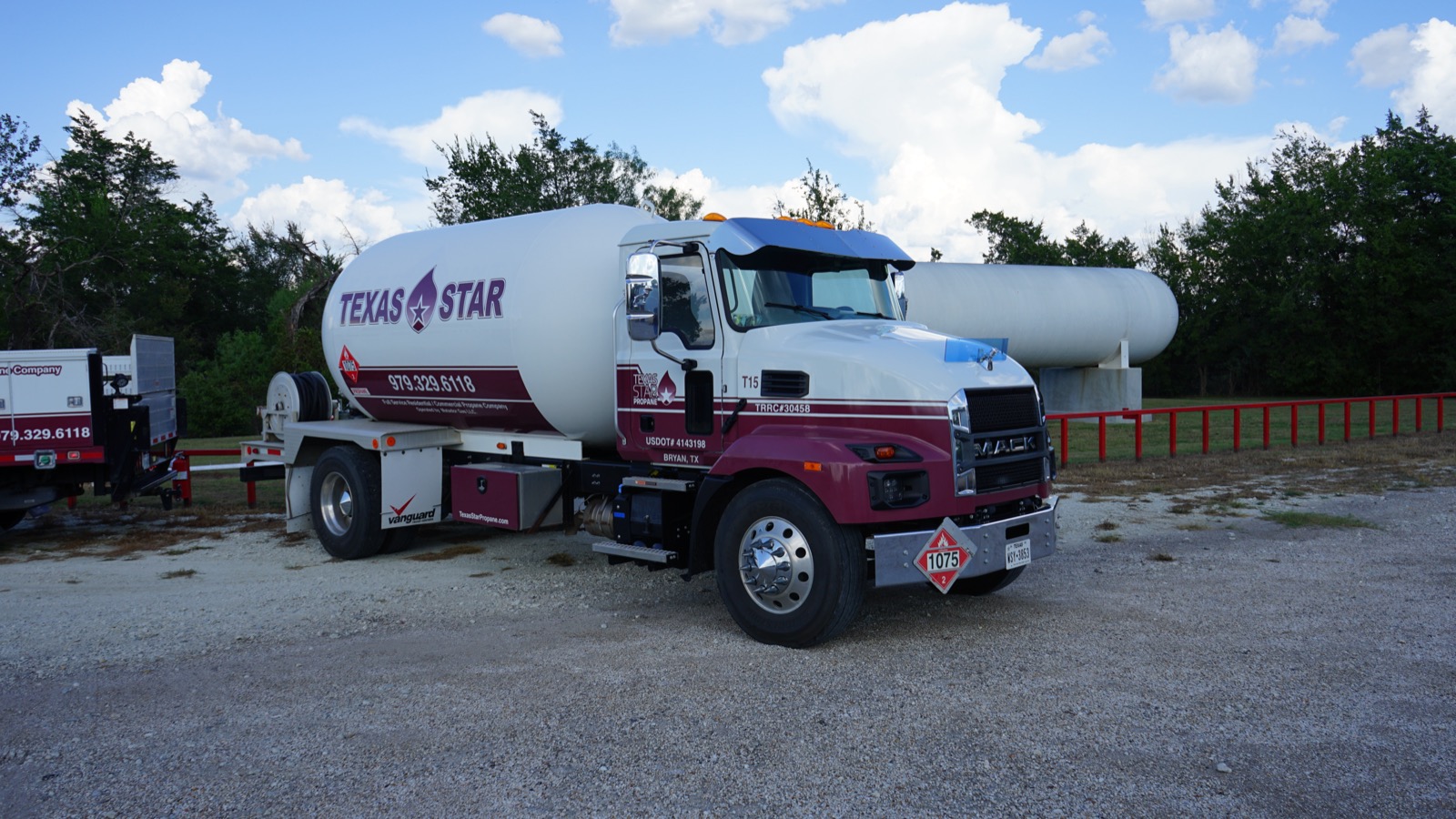
Your delivery goes on a route, not a dispatch. We group orders by area so one truck covers a lot of ground in a day, which is why a little notice gets you a better window than a same day call. If you are out past Navasota or Anderson, that grouping is what keeps the cost sane for everybody on the road that morning.
What to do before the truck arrives
- Clear the way to the tank, including anything parked in front of it, and unlock a gate if the tank is behind one
- Make sure the driver can see the tank and reach the cap
- Put the dogs inside while the crew is working
It takes a minute and it saves a wasted trip. A driver who cannot safely reach your tank has to leave and come back, and that second trip is a day neither of us planned on.
What the driver checks before filling
Before any gas goes in, the driver confirms the tank is sound and holding pressure. If it does not pass, it does not get filled. That is not us being difficult, it is the rule, and it is the same rule at every reputable company in this business.
Which setup is right for your house?
If you only read one section, read this one. Find the row that sounds like your house.
| If this is your house | What we would put you on | Why |
|---|---|---|
| Propane is your heat | Automatic delivery | Usage spikes in the cold, which is exactly when you stop checking |
| Propane runs the kitchen and hot water | Automatic delivery | Steady year round use is easy for us to predict accurately |
| Propane runs a grill or a fireplace only | Will call | Light use, and you would notice it stop |
| A weekend or seasonal place | Will call, with a fill before you arrive | Nobody is there to watch the gauge between visits |
| A pool or spa heater | Will call in season | Usage is concentrated into a few months |
| You have run out before | Automatic delivery | A second runout costs you another leak check |
Frequently asked questions
How do I know when to call for propane?
Watch the gauge, not the calendar. Phone us while there is still a comfortable margin in the tank and we will fit you onto a route. If you are not sure what your margin should be, call the counter and we will tell you straight.
Why does a full tank only read 80 percent?
Propane expands when it warms up, and that top fifth of the tank is the room it needs to do that safely. A full tank reading 80 percent is a full tank.
What happens if I run out?
The line loses pressure, and by law a technician has to run a leak check before anything is relit. That is a scheduled service call rather than a fill, which is why running out costs more and takes longer than a delivery.
Do I own my tank or lease it?
Either is possible and it changes who is responsible for the tank itself. Check your agreement, and if you are not sure, call us and we will look it up for you.
How much notice do you need for a delivery?
A few days gets you a better window than a same day call, because deliveries go out on area routes. In a cold snap that gap widens, which is the argument for automatic delivery.
Can I switch from will call to automatic delivery?
Yes, and it is a phone call. We will look at what you have used so far and set the schedule from there.
We run out of Plantersville, Huntsville and Bryan, and we cover twelve counties across North Houston and East Texas. We know the roads out here. If you want a straight answer about your tank, your usage or your options, call the counter and talk to a real person.
We deliver propane across twelve counties in North Houston and East Texas, out of Plantersville, Huntsville and Bryan.
Texas Star PropaneFM 1774, Plantersville, TX 77363
(281) 259-2162
Questions about your propane or your equipment?
Talk to someone local who knows these roads. Texas Star Propane delivers across southeast and central Texas, and we service the equipment too.