
To read a propane tank gauge you need no tools and under a minute. Lift the dome, find the round dial, and read the number the needle points to. That number is the percentage full, not gallons. If you smell gas at any point, stop, walk away from the tank and call us on (281) 259-2162.
Reading your own gauge is the single most useful habit a propane customer can build. It is the difference between booking a delivery and booking an emergency.
What sits in the tank is a liquid under pressure that becomes a gas on its way to your appliances. Propane is one of the hydrocarbon gas liquids, and the US Energy Information Administration sets out where they come from.
How to read your propane tank gauge
Six steps, and none of them need a tool
- Find the dome on top of the tank. It is the hinged lid at one end of a horizontal tank, or on top of a vertical one. Lift it. On most tanks it simply flips up, and nothing under it is dangerous to look at.
- Find the round dial. Under the dome you will see several fittings and one dial that looks like a clock face, usually numbered from 5 to 95. That dial is the float gauge. Done right, you are looking at a needle pointing at a number.
- Read the number the needle points to. That number is the percentage of the tank that is full. It is not gallons. Done right, you have a number between 5 and 95.
- Multiply by your tank size to get gallons. A 500 gallon tank at 30 percent holds about 150 gallons. A 250 gallon tank at 30 percent holds about 75. If you do not know your tank size, call us and we will look it up on your account.
- Write the number and the date down. One reading tells you where you are. Two readings a month apart tell you how fast you are burning gas, which is the thing that actually predicts when you need a delivery.
- Check it monthly, and weekly in a cold snap. Usage in January is not usage in October. Done right, you never find out you are low by the heat stopping.
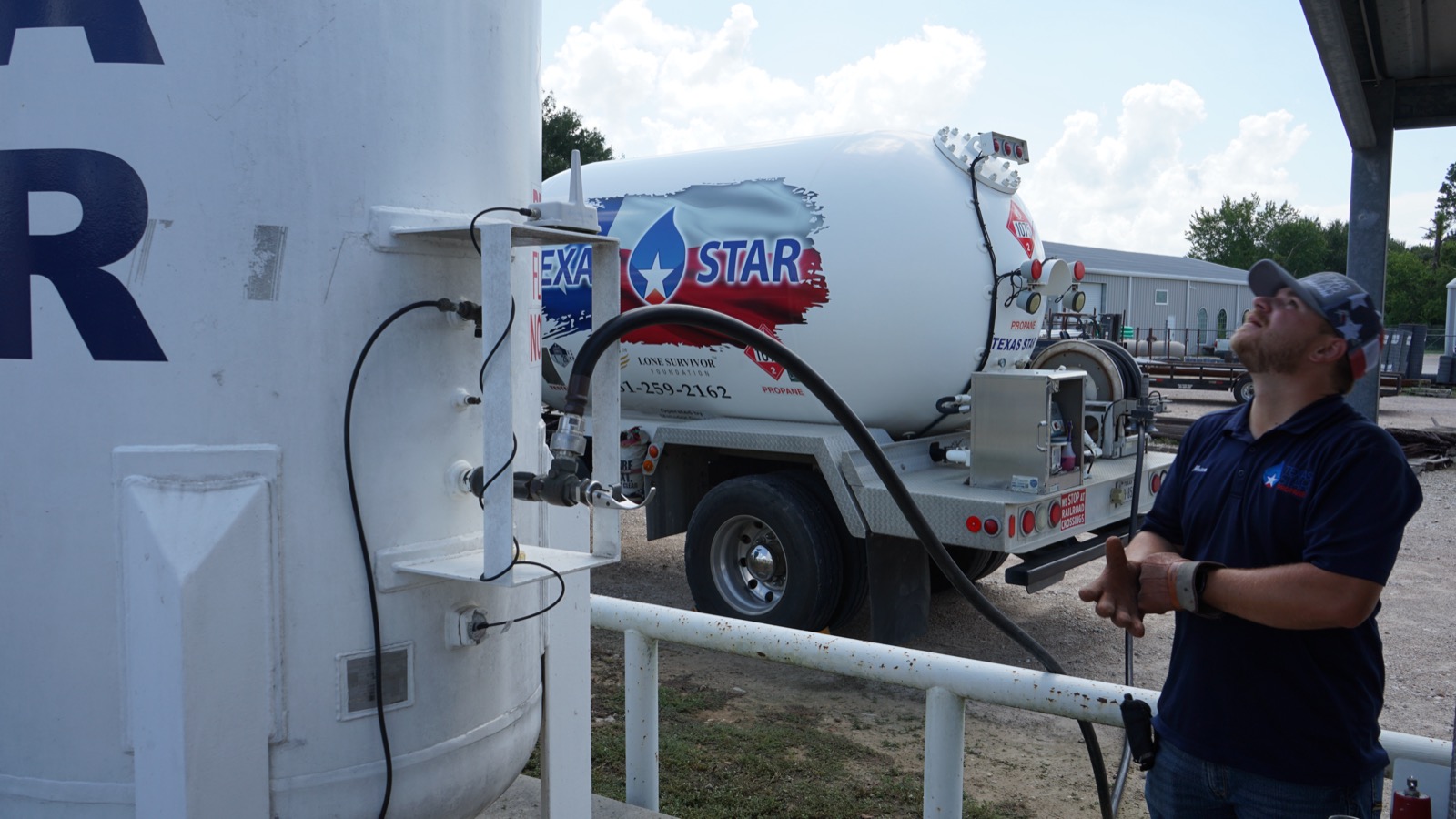
Why a full tank reads 80 percent
This catches out almost every new propane customer. You watch a delivery, the truck pulls away, you lift the dome expecting 100, and the needle is on 80.
What the empty fifth is actually for
That is correct and it is deliberate. Propane expands as it warms, and the top fifth of the tank is the space it needs to do that safely. A tank reading 80 percent straight after a fill is a full tank. Nobody short filled you.
When to stop and call a professional
Lifting the dome and reading the dial is the whole of the homeowner job. Everything below is ours, with no exceptions:
- You smell gas at the tank, faint or strong. Walk away and call from a distance.
- The dial is fogged, stuck, or reads the same number week after week while you are clearly using gas.
- The needle is below 10 percent. That is a delivery, and soon.
- Anything under the dome looks damaged, corroded, or wet with something.
- You cannot get the dome open. Do not force it.
Common mistakes
Reading the number as gallons
Reading the number as gallons rather than percent is the big one, and it is how a 500 gallon tank at 20 percent gets mistaken for a comfortable 100 gallons left when it is actually 100 gallons and falling fast.
Waiting for the needle to bottom out
Waiting for the needle to reach the bottom before calling is the second. Book while there is still margin, because a route has to reach you.
Blaming temperature swing on a leak
Reading the gauge on a hot afternoon and again on a cold morning and assuming gas disappeared is the third. Temperature moves the reading a little, and it is not a leak.
Checking once in October and not again until the heat stops is the fourth, and it is the one that produces most of our emergency calls.
How much you should expect to burn is covered in how much propane a home uses, and the full delivery picture is in our guide to how propane delivery works.
We deliver propane across twelve counties in North Houston and East Texas, out of Plantersville, Huntsville and Bryan.
Texas Star PropaneFM 1774, Plantersville, TX 77363
(281) 259-2162
Questions about your propane or your equipment?
Talk to someone local who knows these roads. Texas Star Propane delivers across southeast and central Texas, and we service the equipment too.